
SEO is evolving at a faster pace than ever before.
AI engines like Gemini, ChatGPT, and Claude are reshaping the way users find information. Users are no longer relying solely on traditional SERPs, they are getting answers directly from AI.
This means your next win isn’t just ranking on Google, but being cited and mentioned in AI tools. So, it’s time to start thinking outside of Google and focus on Gemini SEO as well.
What is Gemini SEO?
It refers to optimizing your content and brand visibility for Gemini (Google’s AI assistant), so your website or content gets mentioned, cited, or recommended directly within AI-generated answers, not just ranked on traditional Google search results.
And it matters, because:
- Gemini is increasingly integrated into Google Search, especially AI Overviews.
- Users no longer click traditional links for answers, they get summaries instead.
- If your content is structured and credible enough, Gemini may cite your site as a source.
AI models look for clear, factual, structured, and authoritative content. So if your website checks those boxes, Gemini is far more likely to use it in its answers.
15 SEO Strategies for Gemini
Let’s know the techniques that can be used to grow traffic from Google Gemini,
1. Write in Question-and-Answer Format
Gemini is designed to answer questions, not scan keywords.
So you must write like the user asks and you answer.
Example:
- Bad: “Keyword research is an important SEO practice.”
- Good: “What is keyword research and why is it important for SEO?”
It increases your chances of being used in Gemini’s natural-language responses.
2. Use Long-Tail and Conversational Keywords
AI tools favor natural, conversational language.
Focus on long-tail keywords like:
- “How to optimize for Gemini SEO”
- “Best AI SEO strategies for 2026/2027”
- “How to get cited by Gemini answers”
These queries mimic how users talk to AI. Tools like Keywords Everywhere, AnswerThePublic, or Google’s “People Also Ask” can help you discover them.
3. Structure Your Content Logically
AI models rely on structured data to understand context.
Use:
- H2s and H3s for clear hierarchy
- Lists and tables for easy summarization
- Short paragraphs (2 – 4 lines)
- Bold key points
This makes it easier for Gemini to parse your content and use it in concise summaries.
4. Add Schema Markup (FAQ + HowTo + Article)
Gemini and other AI engines rely heavily on structured data (schema).
Add FAQPage, HowTo, and Article schema using tools like:
Example:
{
  "@type": "FAQPage",
  "mainEntity": [
    {
      "question": "What is SEO for Gemini?",
      "acceptedAnswer": {
        "text": "SEO for Gemini means optimizing content for AI-generated answers..."
      }
    }
  ]
}
It helps AI systems read your content in a machine-friendly format.
5. Publish Fact-Based, Data-Driven Content
Gemini pulls answers from factual, verifiable data.
Add:
- Statistics
- Research sources
- Original data
- Screenshots or examples
Example:
“According to Semrush (2026), 61% of marketers believe AI summaries will replace featured snippets.”
AI models like that because they prefer content that sounds trustworthy and referenced.
6. Build Topical Authority Around One Core Theme
AI engines reward topic depth, not just keyword repetition.
So instead of publishing random posts, build a content cluster around one niche.
Example cluster:
- “What is SEO for Gemini?”
- “How to rank your website in AI answer engines”
- “Generative Engine Optimization (GEO) guide”
- “How Gemini sources its answers”
Interlink all related articles using descriptive anchor text.
This signals topical expertise, increasing your “AI visibility score”.
7. Use Author Pages and E-E-A-T Optimization
AI models prefer trusted, expert authors.
Follow Google’s E-E-A-T framework:
- Experience: Show real use cases or screenshots.
- Expertise: Add author credentials.
- Authoritativeness: Link to credible sites or studies.
- Trustworthiness: Add contact details, About page, and privacy policy.
Example:
“Written by Hridoy Rehman, SEO specialist and founder of SEO Wins.”
That makes your site more “trust-citable” for AI responses.
8. Target “AI Search Visibility” Through Google SEO
Gemini’s web browsing and data retrieval often come from Google’s index.
So, boosting your Google SEO indirectly improves your Gemini SEO.
Here’s how:
- Submit your site to Google Search Console
- Earn backlinks from higher authority websites
- Optimize for speed
- Target question-based search snippets
If Gemini cites sources from Google, you want to be in that list.
9. Focus on Clear and Contextual Language
Gemini values clarity.
Avoid over-optimization or keyword stuffing.
Instead, write contextually rich sentences that help the AI interpret meaning.
Example:
“SEO for Gemini focuses on optimizing content for AI-based answer engines like Gemini, ChatGPT, and Copilot.”
This gives AI context without repetition.
Tip: Use semantically related terms (LSI keywords) such as:
- AI SEO optimization
- Generative search visibility
- Rank in AI-generated answers
- Gemini ranking guide
10. Update Your Content Frequently
AI models often rely on fresh data.
Outdated pages are less likely to appear in Gemini responses.
That’s why existing content optimization is required.
Set a reminder every 60 – 90 days to:
- Update stats
- Refresh examples
- Add a new section
- Change the “Last Updated” date
Active pages signal ongoing relevance, a major trust signal for AI engines.
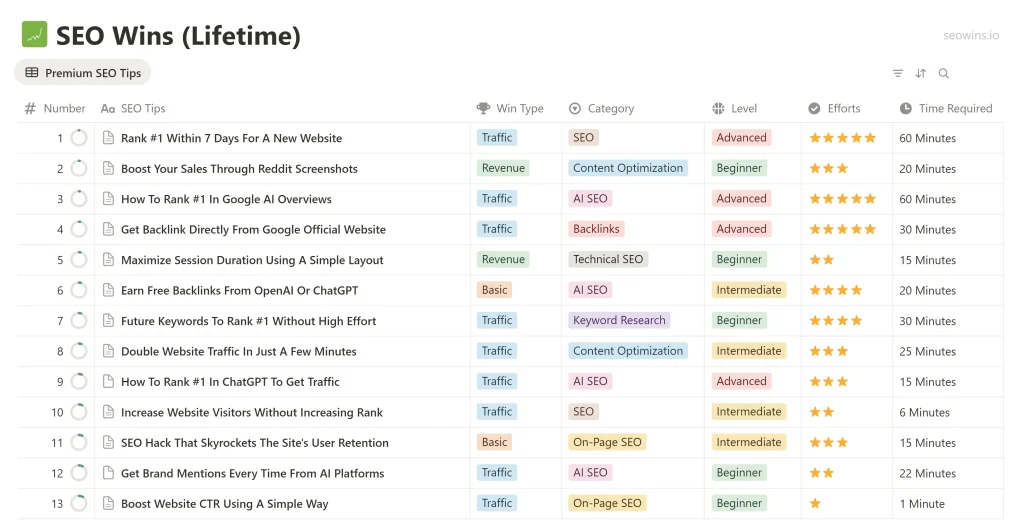
🔥 SEO Wins Database
Use 150+ SEO and AI SEO strategies to boost traffic from search engines like Google, Bing, etc., and AI platforms like ChatGPT, Perplexity, etc., to boost revenue faster.
11. Earn Mentions and Citations
Gemini doesn’t just use backlinks, it values brand mentions and citations.
How to build them:
- Publish guest posts on reputable sites
- Collaborate on expert roundups
- Get listed on directories
- Participate in podcasts or interviews
- Write comments on Reddit and mention your brand name
Even an unlinked brand mention helps Gemini identify your authority in that topic space.
12. Optimize for Featured Snippets and Zero-Click Answers
Featured snippets on Google often overlap with AI Overviews answers.
If you can win a snippet, you’re likely to be cited by Gemini too.
Here’s how:
- Use “What is”, “How to”, “List of” headings
- Answer directly in 40 – 60 words under that heading
- Add lists for “steps” or “tips”
Example:
What is Gemini SEO?
Gemini SEO means optimizing your website so that AI models like Gemini can understand, reference, and cite it in AI-generated responses.
Perfect AI summary content.
13. Optimize Images, Captions, and Alt Text
AI crawlers also analyze images, especially if your page has infographics or data visuals.
Add:
- Descriptive filenames (e.g.,
seo-for-gemini-strategies.png) - Alt text that explains what’s inside the image
- Captions that summarize the data point
These visuals make your page richer and more reference-ready.
14. Test Prompts to See If You’re Cited
Search your own niche inside Gemini.
Example:
- “What are the best SEO tools for 2026?”
- “What is SEO for Gemini?”
- “Top AI SEO techniques for marketers.”
If your content doesn’t appear, tweak your headings and phrasing.
Make your titles sound like questions Gemini users actually ask.
15. Create Tools or Interactive Assets
ChatGPT often references unique utilities, not just blog posts.
Build free web tools like us, such as:
- “Gemini SEO Score Checker”
- “AI Visibility Audit Tool”
- “Schema Generator for FAQ SEO”
Then write blog posts about each one.
This gives Gemini something unique to cite when users ask for tools, not just text.
Bonus: Emerging Gemini SEO Techniques
Now, let’s look at 2 bonuses,
1. GEO (Generative Engine Optimization)
GEO is the evolution of SEO for AI answers.
It’s about optimizing for summarization, not for ranking.
This means:
- Use summaries at the top of articles
- Provide fact-based intros
- Format each section to be easily quotable
2. Multi-Platform SEO
AI engines pull data from multiple sources like websites, social media, PDFs, YouTube captions, etc. So cross-post your content in LinkedIn, Threads, Medium, etc. to increase visibility.
SEO for Gemini Checklist
| Area | Optimization Focus |
|---|---|
| Content Format | Use Q&A, lists, short paragraphs |
| Keywords | Long-tail, conversational, AI-focused |
| Schema | FAQ, HowTo, Article |
| Authority | E-E-A-T, author bio, citations |
| Freshness | Update content every 60 – 90 days |
| Visibility | Earn mentions, featured snippets |
| Technical SEO | Fast, mobile, Bing submission |
| Monitoring | Test prompts, watch citations |
| Advanced | GEO formatting, llm.txt, AI tools |
Conclusion
Gemini isn’t killing SEO, it’s transforming it.
To succeed, you must shift your mindset from ranking for keywords to being cited.
That means:
- Structuring content for easy summarization
- Writing in natural Questions and Answers format
- Building topic authority
- Earning mentions across the web
As AI-driven search grows, visibility in Gemini will be the new digital currency.
If you master Gemini SEO now, you will not only dominate future AI answers but also stay ahead of every marketer still chasing the old Google-first model.
More SEO Tips: